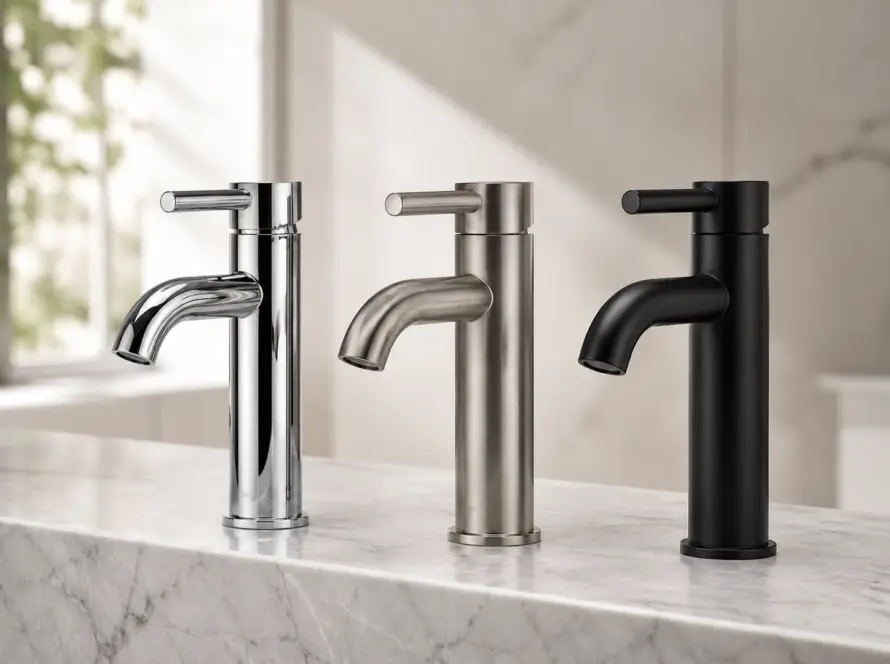

Material choice is one of the most consequential decisions in faucet sourcing. The body material determines not only the product’s weight and feel, but also its lifespan, corrosion resistance, and eligibility for key market certifications. For wholesale buyers, understanding the practical differences between brass and zinc alloy is essential to making the right call for each product tier.
Brass: The Professional Standard
Brass — specifically dezincification-resistant (DR) brass or low-lead brass such as CW617N or C46500 — has been the benchmark faucet body material for decades. Its advantages are well established.
Brass machines cleanly, casts with excellent dimensional accuracy, and accepts chrome plating with strong adhesion. More importantly, brass resists dezincification and stress corrosion cracking in chlorinated water systems, which means it holds up over years of daily use without structural degradation.
For any project targeting the European, North American, or Australian markets, brass is typically required to meet drinking water contact standards such as NSF/ANSI 61 (US), AS/NZS 4020 (Australia), or the EU’s 4MS framework. In most cases, zinc alloy bodies simply cannot pass these certifications.
Zinc Alloy: Lower Cost, More Limitations
Zinc alloy (commonly Zamak 3 or Zamak 5) is significantly cheaper to produce than brass. It casts at lower temperatures, fills complex mould geometries more easily, and is widely used in entry-level and decorative faucet lines.
However, zinc alloy is more brittle than brass and more vulnerable to corrosion over time — particularly in hot water or chemically treated water systems. Zinc bodies can develop internal pitting and surface blistering within two to three years under demanding conditions, leading to leaks and cosmetic failure.
Zinc alloy faucets also tend to be noticeably lighter than brass equivalents. While this can reduce shipping costs marginally, it can also signal lower perceived quality to end users who associate weight with durability — particularly in the mid-to-upper market segments.
When Zinc Alloy Makes Sense
Zinc alloy is not inherently a poor material — it simply serves a different market position. For price-driven retail channels, short-lifecycle rental fit-outs, or decorative non-contact applications (such as furniture handles or shower accessories), zinc alloy offers an acceptable cost-performance balance.
The key is transparency. If you are sourcing zinc alloy faucets, ensure your supplier is upfront about the body material and plating specification, and that the product is marketed and priced accordingly. Problems arise when zinc alloy products are positioned — or priced — as brass equivalents.
How to Verify Material on the Factory Floor
There are a few practical ways to confirm faucet body material during a factory visit or sample inspection.
Weight is the first indicator. A single-lever basin mixer with a brass body typically weighs between 800 grams and 1.2 kilograms. The same design in zinc alloy will often come in under 500 grams.
A scratch test on an unfinished area reveals colour: brass shows a warm yellow tone, while zinc alloy is a pale silver-grey.
For formal verification, request a material test certificate (MTC) tied to the specific production batch. Reputable suppliers maintain these as standard practice.
Our Position
We manufacture primarily in brass — H59 copper alloy for standard lines and low-lead brass for markets with strict drinking water compliance requirements. We do produce select zinc alloy accessories and trim components where the application allows, and we label these clearly in our product specifications.
If you are unsure which material suits your target market, send us your requirements. We will recommend the right specification and provide supporting test documentation so you can source with confidence.