
A faucet that fails in the field costs far more than a faucet that fails on the production line. For importers, distributors, and project buyers, understanding factory-level quality control is essential — it tells you whether a supplier is serious about consistency or simply pushing volume.
Here are five tests that every reliable faucet manufacturer should perform before a single unit leaves the factory.
1. Air Pressure Leak Test
Before any surface finishing, every faucet body is sealed and pressurized with air — typically at 0.6 to 0.8 MPa — then submerged in water. Escaping bubbles reveal micro-cracks, porous castings, or defective seals invisible to the naked eye.
This is the single most important test in faucet production. A body that leaks air will leak water, and a leaking faucet installed on a job site means callbacks, claims, and reputational damage for everyone in the supply chain.
2. Water Flow and Pressure Test
Each assembled faucet is connected to a water supply and tested under working pressure — usually between 0.1 and 1.6 MPa — to verify flow rate, pressure consistency, and drip-free shut-off. This test confirms that the cartridge, aerator, and internal waterways function as a complete system, not just as individual parts.
Flow rate testing also validates compliance with regional water efficiency standards such as WaterSense (US) or WELS (Australia).
3. Cartridge Endurance Test
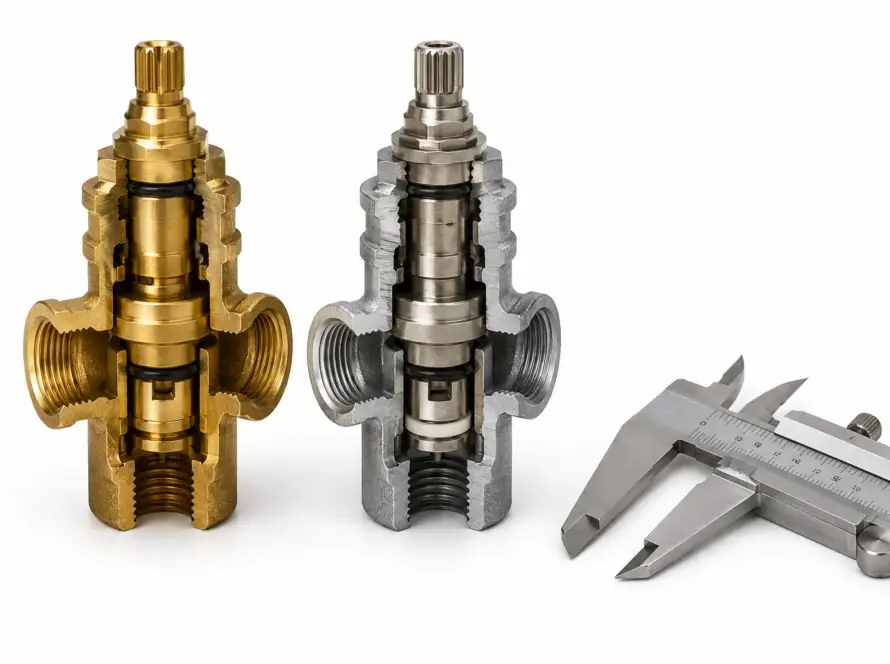
The valve cartridge is the heart of a faucet, and its lifespan defines the product’s practical durability. Industry-standard endurance testing cycles the cartridge open and closed under load — a minimum of 200,000 cycles for entry-level products and 500,000 or more for commercial-grade lines.
When evaluating a supplier, ask for their cartridge endurance data and the test standard used. Suppliers who test to EN 817 or GB/T 18145 are working to recognized benchmarks rather than internal estimates.
4. Salt Spray Corrosion Test
Surface finish durability is measured through accelerated corrosion testing. Finished faucets are placed in a salt spray chamber and exposed continuously — 24 hours for basic chrome, 200 hours or more for high-grade PVD or multi-layer plating.
Salt spray results predict how a finish will hold up in humid coastal environments and hard-water conditions. If a supplier cannot provide salt spray test hours for their plating, consider it a red flag.
5. Plating Adhesion Test
Even a beautiful chrome finish is worthless if it peels. Adhesion testing applies thermal shock — rapidly cycling the faucet between hot and cold environments — then inspects the surface for blistering, flaking, or discoloration. Some factories also use a cross-hatch scratch test to measure coating bond strength directly.
This test catches plating defects that only appear weeks or months after installation, when the faucet is exposed to daily temperature changes from hot and cold water use.
Why It Matters for Buyers
These five tests are not optional extras — they are the baseline of responsible manufacturing. A supplier who runs all five consistently is investing in long-term quality rather than short-term margins.
When evaluating a new faucet supplier, request their QC documentation covering these tests. Better yet, schedule a factory visit and see the testing floor in person. At our facility, every test station is part of the standard production line — not a separate showroom setup. We welcome buyers to walk the line and see the process firsthand.